Regional & Community Utilities
Regional & Community Utilities (RCU) is responsible for services and programs critical to maintaining quality of life in the Region including management of wastewater and solid waste, provision of drinking water (in Electoral Areas), drinking water and watershed protection, and engineering/project services.
Regional and Community Services is comprised of four departments: Wastewater Services, Water Services, Solid Waste Services, and Engineering Services.
Wastewater Services
The Wastewater Services (WWS) department operates four wastewater treatment facilities, two septage receiving sites, sewage mains, and twenty-two pump stations between Qualicum Beach and Duke Point. These facilities serve approximately 120,000 Regional District of Nanaimo (RDN) residents in performing the essential process of transporting and treating wastewater from homes and businesses within the RDN. The Director of Wastewater Services and three technical staff are located at the RDN main office. The Superintendents and 24 operations staff are located at the Pollution Control Centres.
Key activities and functions of the department include: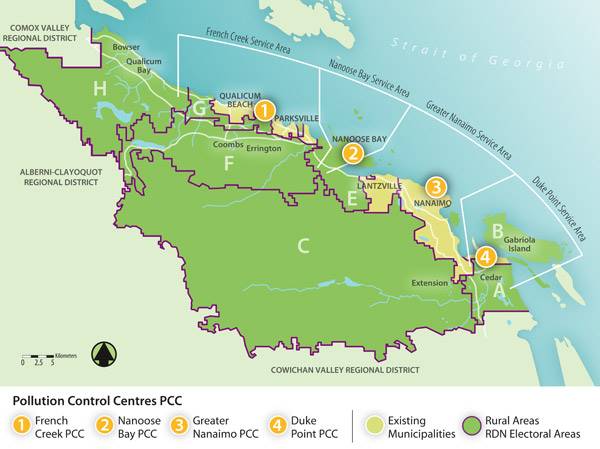
- Operating and maintaining the four regional wastewater treatment plants and related infrastructure so as to comply with Ministry of Environment discharge requirements.
- Maintaining an Environmental Management System (EMS) conforming to ISO 14001 Standards.
- Maintaining a preventative maintenance and asset management program to operationally and financially plan for infrastructure replacement.
- Preparing and managing project and annual department budgets.
- Benchmarking with other jurisdictions across Canada to ensure the WWS operations are efficient and provide RDN service area residents with good value.
- Conducting monitoring and reporting programs for treatment plant effluent discharges, biosolids quality and the receiving environment.
- Administering the Regional District's Liquid Waste Management Plan (LWMP) including source control initiatives, biosolids management programs, volume (inflow and infiltration) reduction strategies and servicing strategies for rural and un-serviced areas.
Treatment Facilities
The Greater Nanaimo Pollution Control Centre is located on Hammond Bay Road in the City of Nanaimo. It serves approximately 94,000 residents within the City of Nanaimo, portions of the District of Lantzville and some Snuneymuxw First Nations lands. The facility is currently undergoing a major expansion and upgrade to secondary treatment.
The French Creek Pollution Control Centre, located on Lee Road in French Creek (Electoral Area G), serving a population of about 28,000 people living in French Creek, the City of Parksville, the Town of Qualicum Beach and smaller areas north of Qualicum (Surfside) and south of Parksville (Pacific Shores). Detailed engineering is currently underway for a major capacity expansion.
The Nanoose Bay Pollution Control Centre in Electoral Area 'E' (Nanoose Peninsula) serves about 1,400 residents. It is scheduled for upgrade to secondary treatment by 2023.
The Duke Point Pollution Control Centre treats wastewater from the industrial park and from some properties located in the Cedar Village Centre (Electoral Area 'A').
Water Services
The Water Services Department operates and manages the stormwater detention facilities, the supply and distribution of drinking water (in Electoral Areas), the collection of wastewater, and the provision of streetlighting services to specified service areas outside of municipal boundaries. It also manages the region-wide Drinking Water & Watershed Protection Program.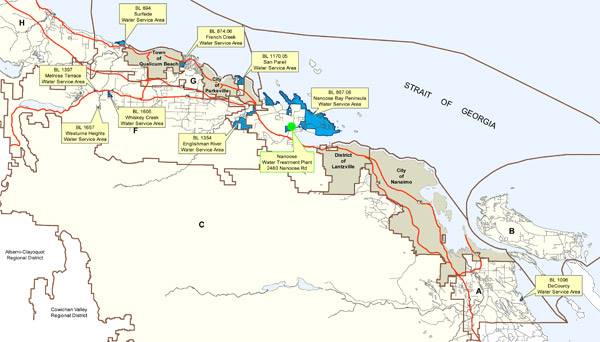
Water services are provided to approximately 3150 properties (in nine water service areas), and sewer services (in six sewer service areas) are provided to approximately 2750 properties. Approximately 14,000 customers are served with water and/or sewer. Water systems are located in Electoral Areas 'A' (Decourcey), 'E' (Nanoose Bay Peninsula), 'F' (Melrose Terrace/Whiskey Creek/Westurne Heights) and 'G' (French Creek/River's Edge/San Pareil/Surfside). A department manager, technologist, technician, project engineer, and four Drinking Water Watershed Protection staff are located at the RDN main office. There are eight field operators that carry out maintenance and service delivery for all systems from the Utilities office located in the Parksville industrial park.
Key activities include:
- Supply, treatment, and distribution of drinking water from groundwater and bulk water sources.
- Maintenance and operation of gravity sewer collection systems and administration of a cross-communication control program.
- Full testing to Canadian Drinking Water and Ministry of Health standards. Supplies consistently meet all health-related criteria.
- Daily, weekly, monthly and annual system maintenance programs in all service areas.
- Providing new service connections as required and service area expansions.
- Participation in the Arrowsmith Water Service/Englishman River Water Service Joint Ventures for water supply from the Englishman River.
- Maintenance of and coordination of street lighting within service areas.
- Team WaterSmart activities throughout the Regional District - an educational based program promoting water conservation and use reduction.
- Implementing the programs in the RDN-wide Drinking Water Action Plan to improve resource protection, conservation, and land use decision-making.
- Develop cooperative partnerships with First Nations, local municipalities, industry, senior governments, and other stakeholders to deliver the Drinking Water Watershed Protection program on a regional basis.
- Review and approval of water, sewer and street lighting system plans and specifications constructed for development within RDN service areas.
- Maintaining current bylaw standards for water supply and distribution, sewage collection and street lighting systems for RDN service areas.
- Asset management, including project execution, for water, sewer collection, street lighting, and stormwater detention services.
Solid Waste Services
Solid Waste Services plans, regulates and delivers solid waste collection and disposal services to residents and businesses region-wide as well as programs for the recycling and diversion of solid waste. Solid Waste plans, policies, programs and facility management are guided by a Provincial Ministry of Environment approved Solid Waste Management Plan.
The Manager of Solid Waste Services and four technical staff are located at the RDN main office. Two superintendents and 33 operations staff are located at the Church Road Transfer Station and Regional Landfill in Cedar.
Disposal Facilities
The Regional Landfill located on Cedar Road in Nanaimo, and the Church Road Transfer Station near Parksville, provide region-wide solid waste disposal to a population of approximately 170,000. The Facilities process approximately 215 tonnes of material per day and are open seven days per week, except for Statutory Holidays.
The regional landfill is a fully engineered site with a liner, leachate collection system, landfill gas collection system, and stormwater management system. The site is subject to a provincial operational certificate that requires annual site development and operating plans, a leachate management plan, landfill gas management plan, an extensive ground and surface water monitoring program, and a closure/post-closure plan.
The Church Road Transfer Station provides efficient transfer of waste and recyclables from the northern communities of the Regional District. Waste from Parksville, Qualicum Beach and the northern electoral areas is brought to the transfer station to be consolidated into larger loads for transfer to the Regional Landfill and other facilities.
Curbside Collection Services:
The Regional District provides curbside collection of waste, recyclables and organics to municipalities and electoral areas in the RDN, with the exception of Nanaimo (which operates its own collection services). The curbside collection service is contracted out and includes weekly collection of household food waste and alternating every-other-week collection of garbage and recyclables. More than 29,000 single-family homes receive this service from the RDN.
Solid Waste Management Planning:
The Regional District has made a long-term commitment to achieving Zero Waste by diverting garbage to conserve resources and landfill space. In addition to disposal bans, and a program for licensing private recycling facilities, the Zero Waste Program includes supporting educational outreach programs.
The RDN has achieved a diversion rate of 68 per cent, and a per capita disposal (landfilled) rate of 347 kg per year, one of the lowest rates in Canada. In 2018, the RDN Board approved an updated RDN Solid Waste Management Plan containing actions to meet the goal of 90 per cent waste diversion from the landfill over the next 10 years. The Organics diversion program is critical to achieving our waste management goals. Food waste collected at the curbside is composted under a contract with Nanaimo Organic Waste (NOW).
Capital Project Delivery
Capital Project Delivery provides project management support to RCU departments and Fire Services. The Capital Project Delivery Manager and two Project Engineers are located at the RDN administration building, and two Project Engineers are located at the wastewater treatment facilities. The Capital Project Delivery team provides in-house expertise to plan, organize, and lead the RDN's major capital projects from initiation through to operation and close-out. The Project Engineers manager project teams typically consisting of both consultants to perform the design engineering and construction management/inspection services, as well as contractors to execute the construction activities. The current five-year plan in RCU includes capital expenditures of over $150 million for rehabilitation, replacement, expansion, and regulatory upgrades of facilities and infrastructure.